ESUT Tasks Staff on Experiential Learning, Soft Skills Development
The Enugu State University of Science and Technology (ESUT) has urged its staff to embrace experiential learning and soft skills development as part of efforts to strengthen leadership capacity and enhance institutional productivity.
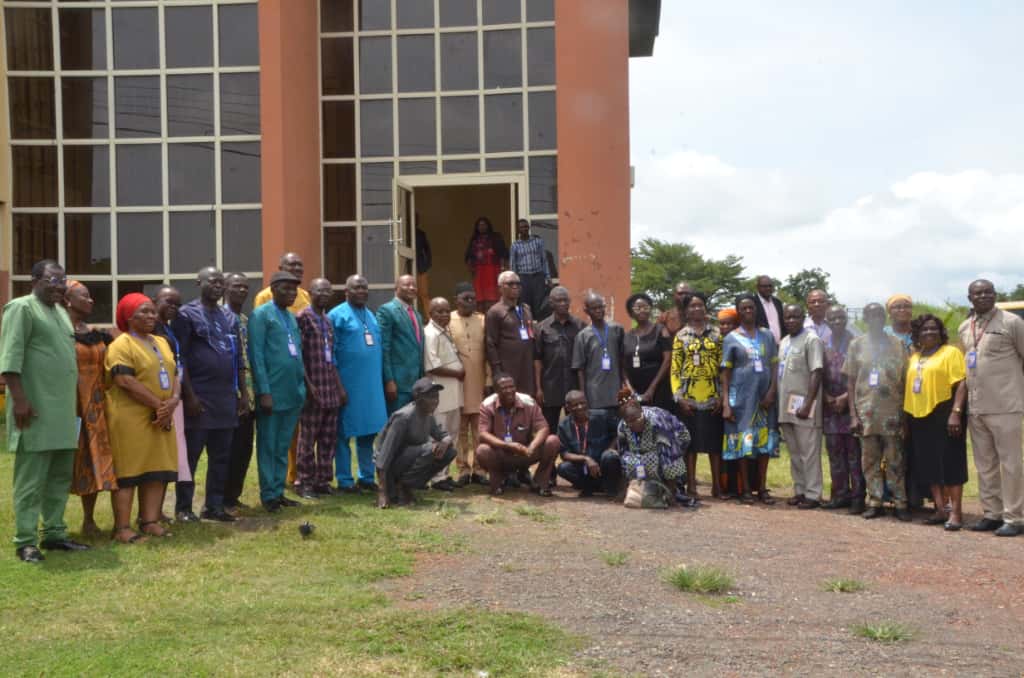
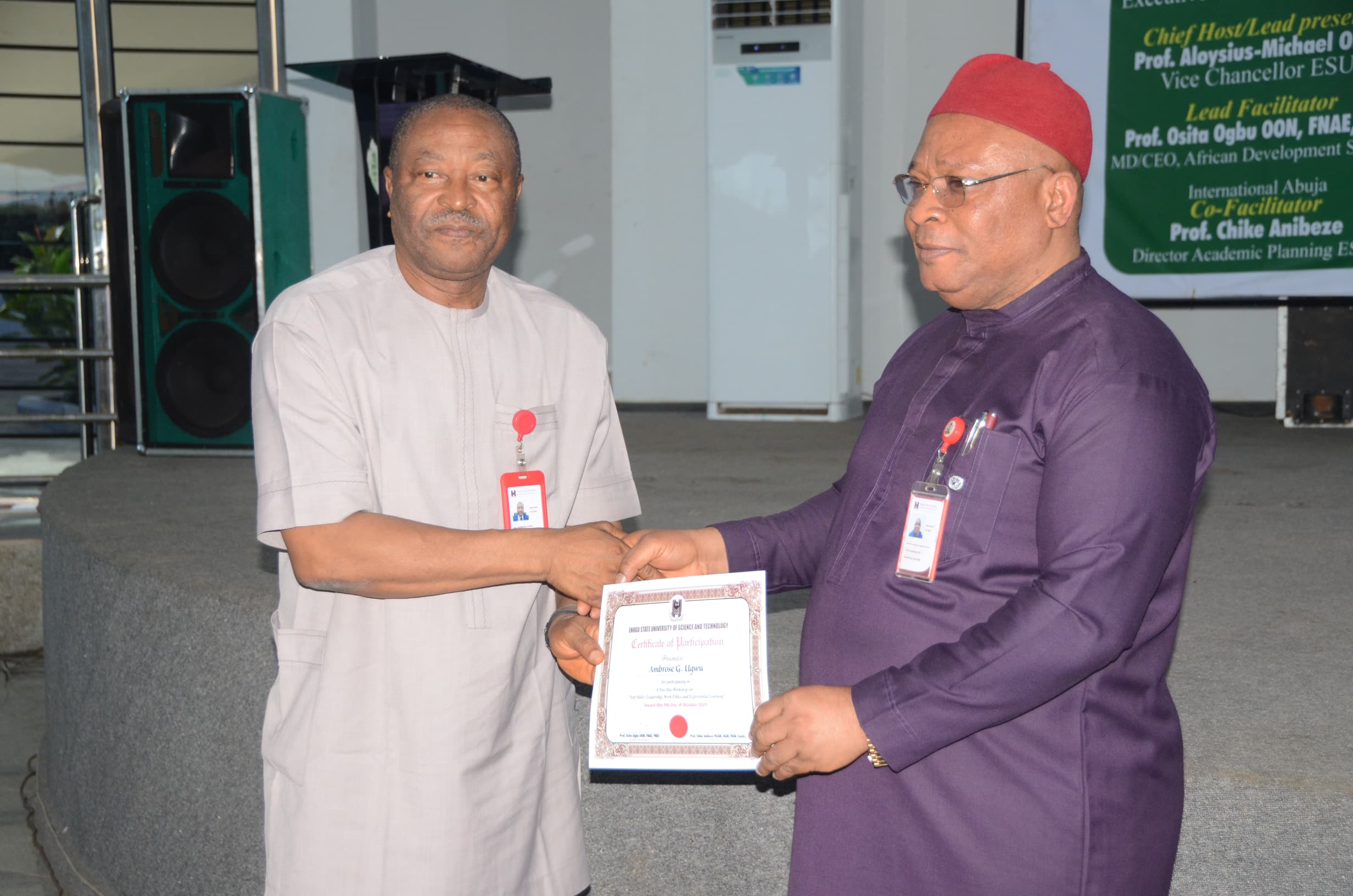
This call was made during a two-day training workshop on Leadership, Work Ethics, Value Orientation and Application of Experiential Learning, held at the International Conference Centre, Enugu on Wednesday 8th and Thursday, 9th October, 2025.
The event, organised for ESUT frontline staff, featured the Managing Director of African Development Solutions International, Abuja, Professor Osita Ogbu, as the lead facilitator.
Speaking on the theme “Creating a Winning Team at ESUT: Lessons Learnt from World Cup Winning Coaches and Other Matters,” Prof. Ogbu, who is former Economic Advisor to former President of Nigeria, emphasized the importance of clear goals, teamwork, and accountability in achieving organisational success.
He advised leaders to inspire and motivate their teams, build confidence, delegate responsibilities, and define what success means for staff in terms of training and career growth.
“Leaders must be candid and reward those who are candid. People must not be encouraged to play office politics or gossip. Sharing ideas requires trust, and trust is built on truth . Leaders have to plan, strategize, prioritize and monitor performances,” he added.
In his lead paper presentation titled “Transformational Leadership, Innovation and Creativity in Tertiary Institutions,” the Vice Chancellor of ESUT, Professor Aloysius-Michaels Okolie, described leadership as a combination of vision, drive, and commitment to achieve set goals.
“Leadership is the art of getting someone else to do something you want done. A leader is one who knows the way, goes the way, and shows the way,” he said.
Prof. Okolie identified transformational leadership as one that inspires innovation and motivates employees to create change that drives institutional success. He noted that such leadership emphasizes authenticity, corporate culture, and employee empowerment.
According to him, experiential learning, an approach that promotes hands-on education, is key to aligning academic outcomes with industry and societal needs.
He said ESUT is adopting the PEARL model, a strategic framework for integrating experiential learning into higher education through lecturer training, resource allocation, and sustainable development.
Also speaking, the Director of Academic Planning at ESUT, Professor Chike Anibeze, in his presentation on “Planning and Implementing Experiential Learning Models: Best Practices for Integrating Hands-on, Real-world Learning Opportunities into the Academic Framework,” highlighted the practical nature of experiential learning.
He explained that experiential learning allows individuals to acquire knowledge, skills, and values through direct experiences rather than passive instruction.
“Experiential learning is our oldest traditional system of education, akin to the apprenticeship model of our forefathers, where knowledge is transmitted through practice. This approach fosters innovation and growth,” he stated.
Prof. Anibeze, who is also a Co-Facilitator of the workshop, cited examples such as internships, apprenticeships, simulations, fieldwork, laboratory experiments, group projects, and outdoor education as key components of experiential learning.
In his presentation titled ‘Strategic Repositioning of M. I. Okpara’s Leadership and Governance as a Competency-Based Institutional Framework for Sustainable 21st Century Impacts,’ Hon. Dr. Barr. Chinedu Onu (Agunaecheibe) said that “leadership that does not evolve, cannot endure.”
Dr. Onu emphasized that leadership is the architect of institutional and national destiny, capable of turning potential into achievement and crises into opportunities. He argued that the 21st century, marked by rapid technological, environmental, and social changes, requires a transformation in leadership philosophy and practice.
The workshop aimed to strengthen the capacity of ESUT staff to deliver quality education and leadership in line with global best practices.


News Via Inbox
Subscribe to our newsletter to get latest news updates in your mailbox